

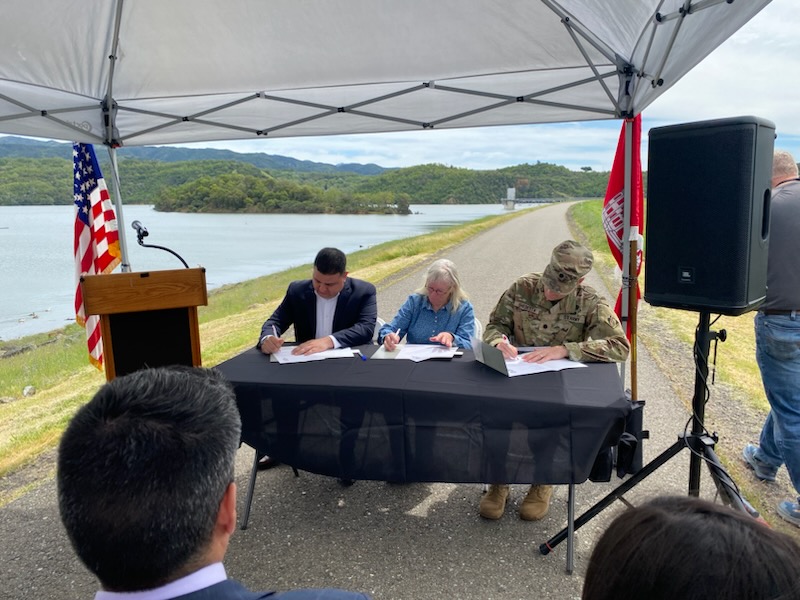

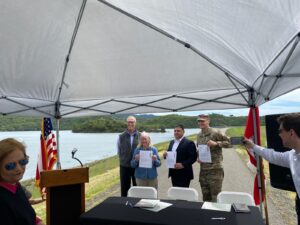
 Left Congressman Huffman, Janet Pauli (Inland Water & Power), Andy Mejia (Lytton Tribal Chair), Shebesta (US Army Corps Commander)
Today, U.S. Representative Huffman announced a funding allocation for some of the studies necessary to raise Coyote Valley Dam at Lake Mendocino. This is one of many necessary steps our community is going to need to take to further our watershed’s ability to weather additional drought years and to better take advantage of any future Eel River diversions. It is time that we work together towards effective solutions as opposed to unnecessarily wasting time and resources on changing an outcome that has already been decided by PG&E.
For years now, PG&E has been losing money on the operation and maintenance of its two dams on the Eel River. Its ability to generate hydropower via the Potter Valley Project has been significantly negated by expensive equipment failures. Climate change and Eel River fishery needs have drastically reduced the amount of water available to divert to the Russian River for more than twenty years. Plus, serious seismic concerns with the dam at Lake Pillsbury on the Eel River have been raised by PG&E and both State and Federal governments. All issues have fundamentally changed how the Eel River dams and Potter Valley Project operate. Ultimately, these issues have all led to PG&E making the business decision to cut their growing losses and decommission their interests.
Over the years, and as part of the Two-Basin Solution, tribes, community stakeholders (e.g., Mendocino and Sonoma County Farm Bureaus, Russian River water users, Sonoma Water, state and federal agencies, Environmental and Fishing groups, etc.), and government interests from both water basins have tried to devise a potential path forward that would allow for a continued diversion to the Russian River, while simultaneously addressing the growing set of environmental issues on the Eel River and PG&Es desire to remove itself completely from the Eel River. Sonoma Water, Mendocino County, Humboldt County, Eel River tribes and CalTrout formed a coalition to investigate taking over the Potter Valley Project from PG&E. Due to the exorbitant costs of retrofitting the dams to address safety and environmental concerns and then subsequently operating and maintaining the facilities—there was simply no way the coalition, or anyone else for that matter, could come together to takeover the entire project from PG&E on a long-term basis. As such, PG&E moved forward with its dam removal and decommissioning plan.
With the question of dam removal settled, regional partners continued to work towards a more discrete option of what a future water diversion to the Russian River may look like for both basins. This ultimately culminated in an MOU signed by regional partners in February of this year. Some of the key pieces of this MOU are:
- The oldest water rights on the Eel River are rightfully returned to the Round Valley Indian Tribe;
- The Round Valley Indian Tribe will receive payment of up to $2 million per year for diversion of its water rights to the Russian River, a small proportion when compared to the typical costs of water in California and elsewhere in our watershed;
- A diversion schedule committing to continued water transfers during the wet season and when the Eel River has excess flows, unlike now where diversions are variable from year to year and sometimes non-existent;
- A new water diversion facility will be constructed to operate without need for the Eel River dams;
- An initial term for continued water diversion term of 30 years, with a conditional second 20-year term; and
- A unified commitment to support the completion of the water diversion facility and restoration projects in the Eel River through mutual support of state, federal, and philanthropic fundraising efforts.
We are pleased to see this agreement move forward as it provides increased certainty for the Russian River and helps cement our need for proactive measures that help increase our resiliency in the face of climate change and growing demands. We are also hopeful that this MOU helps provide some of the certainty necessary to allow important flow studies in the Russian River to move forward after years of delay. Ultimately, we believe that this brings us one-step closer to a holistic water management process that is designed in the best interest of our river’s health.
While there has been a recent surge in certain stakeholder groups and individuals in the Russian River Watershed vocalizing their discontent with PG&E’s plan and the MOU—it is simply misguided, uninformed, and ignores present-day realities as described above. Instead of trying to bail a sinking ship, or in this case a failing dam, we must focus our money and time on building storage solutions and implementing other proactive measures in the Russian River basin to help improve water reliability with or without an Eel diversion. Only by focusing on the solutions will we have a chance at protecting the communities and ecosystems we hold dear.
Russian River Water Supply Impacts
As we begin to understand what the Russian River will look like post Eel dam removal, it is increasingly clear that we must simultaneously look at what we can do within our own watershed to further protect water supply. There have been several projections put forth by local water agencies and suppliers that show Lake Mendocino could go dry without a future diversion. While this can be a scary thought on its own, we must qualify those projections and provide some additional context as there are still many options available to avoid a dry lake.
First, these projections are largely built on models that reflect no change in water use within our watershed. This means no water conservation or use reduction by urban, industrial, or agricultural users in the projections. It also doesn’t include the expansion of water storage options, recharge actions, or restoration efforts that can help increase water supply. We believe reliance on only this type of modeling does not help us confront the need for significant changes within our own watershed. Changes will inevitably have to occur in how our waters are used and managed in the Russian River—a continued diversion will help meet some demand, but it is not the lone solution. Climate change can quickly reduce any benefits of a diversion so it is vital that our community can extend any benefits for as long as possible.
Necessary changes cannot occur overnight, we need to start taking active steps today to help ensure practices and infrastructure are in place, or at least not at zero when we need them. To take advantage of a winter diversion, there must be a plan in place to reliably store any excess water (e.g., groundwater recharge, individual onsite storage, a raised Lake Mendocino) as it is likely that our existing storage structures will already be full. Excess stored water can then be used in the dry season and when droughts occur.
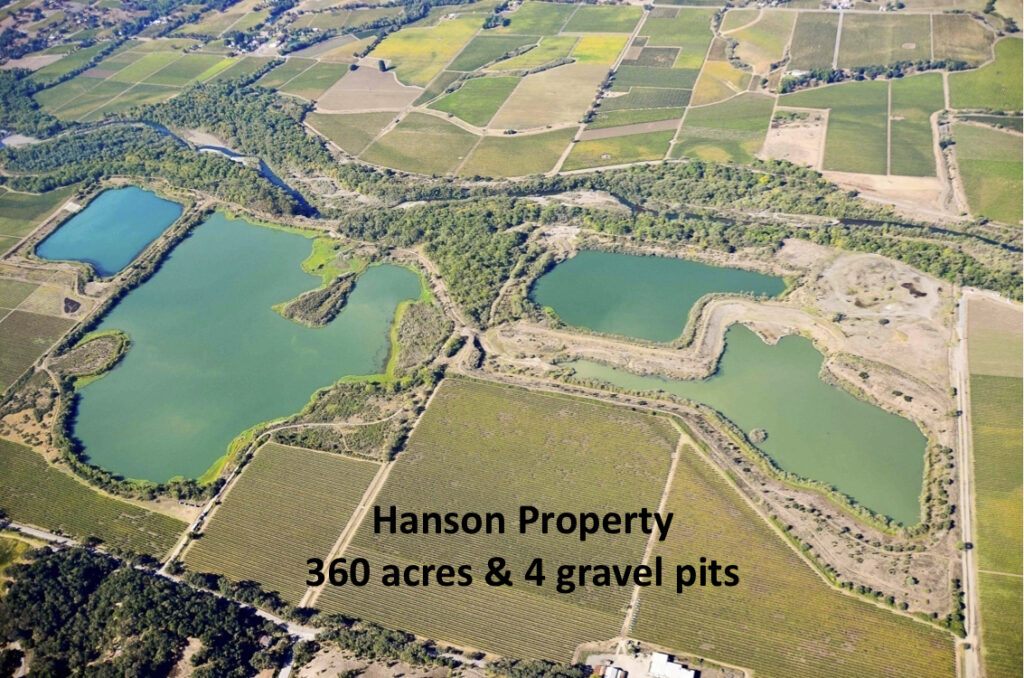
Groundwater recharge is another cost-effective option that involves pulling water from the Russian River during high flow periods and putting it into recharge basins or spreading it over farms. This helps increase available groundwater for local use in dry periods while indirectly benefitting the river’s ecosystem by slowly seeping back into the river to augment flows and reduce temperatures in interconnected areas during our driest months.
Other available solutions include increasing on-farm storage ponds, installing rainwater capture systems, improving water data collection, and using practices that increase soil moisture retention and reduce evaporation. No matter what array of solutions are ultimately pursued, the most important factor is that we begin implementing forward-looking solutions today, rather than cling to the past.
Russian Riverkeeper believes that there needs to be a focus on these important issues now. It is far too common for communities to be reactionary to such issues and that is not to anyone’s benefit. There is a lot of work ahead for us to ensure our watershed is resilient to changes post-removal. However, the time for change is now. Russian River water users must become more self-sufficient in its use to help ensure our watershed can withstand the growing extremes of climate change.
We will work to keep you updated as new information is available. We’re rolling up our sleeves and getting to work. This is a problem that we can solve together to ensure our community and the river have enough water.
This included: Round Valley Indian Tribes (RVIT), the California Department of Fish and Wildlife (CDFW), Humboldt County, Mendocino County Inland Water and Power Commission (MCIWPC), Sonoma Water, CalTrout, and Trout Unlimited.
https://caltrout.org/news/press-release-regional-partners-sign-historic-mou-on-eel-river-recovery